Re-Padding Under Existing Carpet
If your carpet is still in good shape but feels flat, spongy, or has developed odour, the pad underneath is often the actual problem – we can lift the carpet, replace the pad, and re-lay the same carpet.

Tell us about your carpet project and we'll follow up with a quote.
Final scope always follows a free, itemized quote.
What every job includes.
Not a single default product applied everywhere.
The subfloor check drives the recommendation.
When the carpet itself is still good.
We'll tell you honestly rather than upsell a re-pad.
Hallways, stairs and living rooms call for a firmer, higher-density pad.
Can prioritize a softer pad for comfort, since durability demands are lower.
Pad selected with moisture in mind based on what the subfloor check finds.
A softer pad prioritizes comfort in bedrooms.
A denser pad in high-traffic hallways resists matting.
In basements, pad choice affects moisture management.
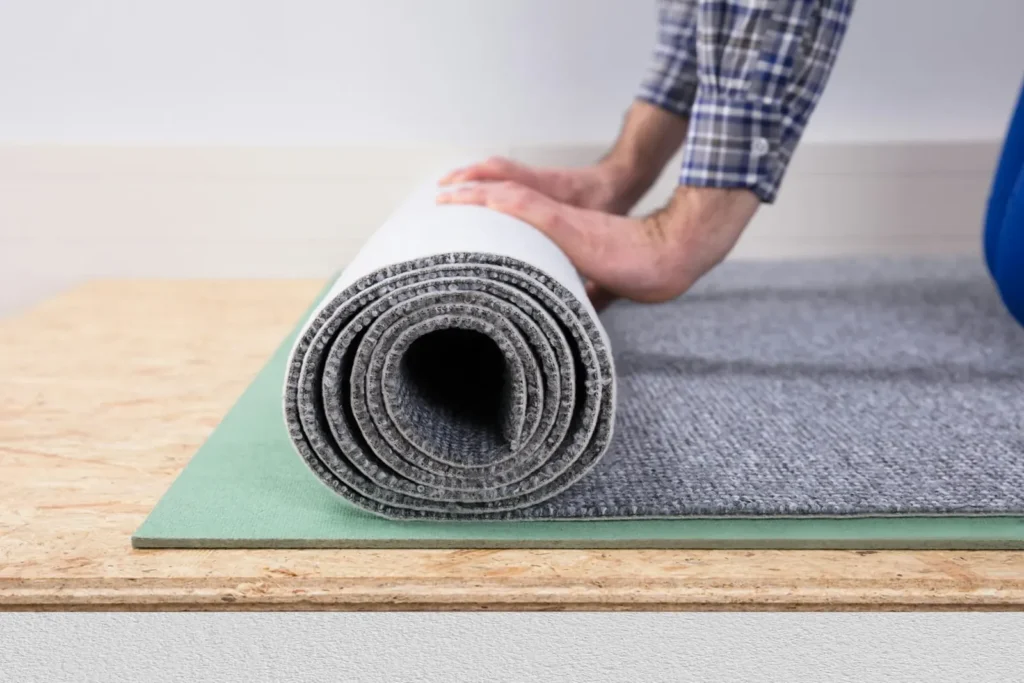
If your carpet is still in good shape but feels flat, spongy, or has developed odour, the pad underneath is often the actual problem – we can lift the carpet, replace the pad, and re-lay the same carpet.
Carpet Experts Calgary provides carpet padding & underlay installation throughout Calgary.
Most residential jobs get bonded urethane (rebond) pad, which recycles high-density foam trimmings into a dense, resilient cushion and offers the best value for most rooms. Beyond that we install frothed foam and memory-foam pads for a more cushioned feel, flat rubber for longevity under heavy traffic, and fiber pads where a firm, low-profile base is needed, such as under some berbers and commercial-style carpets.
Pad is specified by thickness and density. Thickness is what you feel; density is what determines survival. A common residential spec is around 7/16 inch thick at 8-pound density – comfortable and durable for bedrooms and living areas. High-traffic zones do better with denser pad even if slightly thinner. Very thick, low-density pad feels luxurious for a year and then bottoms out; we'll steer you away from it.
Stairs and halls want dense, firmer pad that keeps the carpet stable under concentrated wear. Bedrooms can go softer. Basements need moisture-tolerant synthetic pad. Rooms with heavy furniture benefit from density over plushness. One house often gets two or three pad specs – that's normal, and it costs less than putting premium pad everywhere.
Most carpet manufacturers specify a minimum pad density and maximum thickness for their warranties to hold – commonly at least 6-pound density and no thicker than 7/16 inch for cut-pile residential carpet. Install the wrong pad and a texture-retention warranty can be void before the first footprint. We match pad specs to the carpet being installed and can show you the requirement.
Pad adds measurable insulation between your feet and a cold subfloor. Over a basement slab or above an unheated garage – a common layout in Calgary two-storeys, where the bonus room sits over the garage – a quality pad makes an obvious temperature difference from November through March.
Hydronic in-floor heat under carpet requires the opposite thinking: you want a pad and carpet combination with low combined thermal resistance so the heat actually gets through. If any of your rooms have in-floor heat, tell us – the right spec here is thinner and denser, and combined R-value matters.
Carpet that crunches when you walk on it, visible traffic lanes that shampooing doesn't fix, a floor that feels flat and hard where it used to have give, or odours that return after every cleaning – all point at the pad, not the carpet. Pet accidents especially live in pad long after the carpet surface is clean.
If your carpet still has life but the pad is done, we can lift the carpet, replace the pad, and power-stretch the same carpet back in. It's a fraction of replacement cost and often buys years. We'll be honest when the carpet itself won't survive the lift – older, brittle carpet sometimes doesn't.
Yes, if the carpet itself is in good enough condition to be lifted and re-laid – we'll assess that as part of your quote.
Signs like a spongy or uneven feel, odour that cleaning doesn't fix, or carpet that still looks fine but feels off underfoot often point to the pad. We'll check during a quote visit.
Not necessarily – density matters more than thickness alone, especially in high-traffic areas. We'll match pad specs to the room rather than assuming thicker is always better.